





This New Year goal setting writing prompt helps upper elementary students choose a specific goal, plan the steps to reach it, and show it off on a bulletin board.
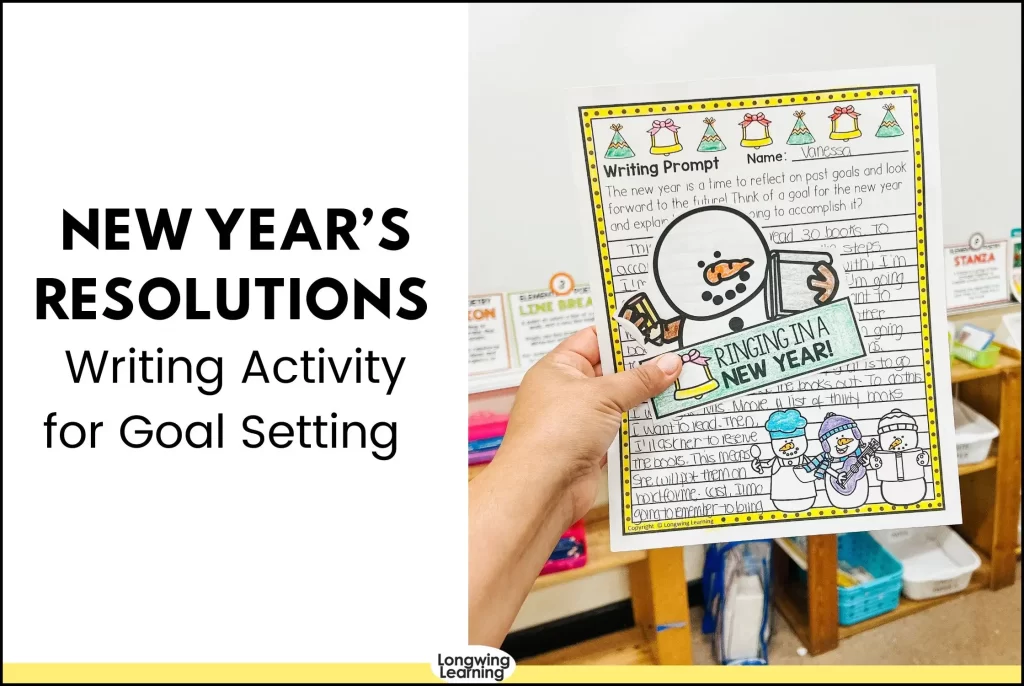
Every January, I like giving my students a chance to start fresh.
The problem is that when I ask fifth graders to set a New Year’s goal, I usually get answers like “get better at math,” “read more,” or “be nicer.”
Those aren’t bad goals, but they’re so broad that students have a hard time explaining how they’re actually going to accomplish them.
That’s why I changed the way I teach this New Year writing lesson.
Before my students ever start drafting, we spend time talking about goals, comparing vague and specific goals, and breaking one goal into small action steps.
[PHOTO: Finished New Year goal setting writing displayed on a classroom bulletin board. Alt text: Student New Year goal setting writing displayed on a classroom bulletin board.]
After winter break, my students are always eager to share what they did and settle back into our classroom routines.
I like using that fresh-start feeling to get them thinking about what they want to accomplish in the year ahead.
In this post, I’ll share how I use this New Year goal setting writing prompt over two days to help my students choose a meaningful goal, make it specific, plan the steps, and turn those ideas into a writing response.
Want to skip ahead? You can grab the New Year’s Goal Writing Prompt from my TPT store.
Why Goal Setting Can Be Difficult for Upper Elementary Students
If you’ve ever asked upper elementary students to set a New Year’s goal, you’ve probably heard answers like “get better at reading,” “do better in math,” or “be nicer.”
Those are not bad goals, but they are usually too broad.
What I notice with my fifth graders is that they often know what they want to improve, but they have a harder time explaining exactly what they are going to do to make it happen.
When the goal is vague, the writing usually becomes vague too.
For example, if a student writes, “I want to get better at reading,” there is not much to explain yet.
So I start asking questions like:
- What are you actually going to do?
- How often are you going to do it?
- What would this goal look like in real life?
- How will you know when you have reached it?
That is how we can move from a goal like “get better at reading” to something more specific, such as “read for 20 minutes every night.”
Once the goal becomes more specific, students suddenly have much more to write about.
Now they can explain why the goal matters, what steps they will take, what might get in the way, and how they will know when they have reached it.
I also like reminding my students that their goal does not have to be academic.
Some students want to improve in school, while others may choose a goal related to kindness, health, learning a new skill, or helping at home.
Giving students different options helps them choose something that actually feels meaningful instead of picking a goal because they think it is what I want to hear.
That is why I added the Goal Choice Board and the Vague or Specific Goal Sort to this writing activity.
Before students begin drafting, I want them to understand what makes a goal specific enough to actually plan for and write about.
How to Teach the New Year Goal Setting Writing Prompt
I like to spread this New Year writing activity over two days.
On Day 1, we complete Steps 1 through 3. We talk about goals, choose one, make it more specific, and plan the action steps.
On Day 2, students use their planning to write, revise, edit, and complete their final drafts.
Here is the prompt students respond to:
“The new year is a time to set new goals! Think of one goal you want to reach this year. Explain why it is important to you and the steps you will take to reach it.”
[PHOTO: New Year writing prompt pages. Alt text: New Year goal setting writing prompt worksheets for upper elementary students.]
Step 1: Start With a Goal Setting Discussion
I like to begin with a New Year’s read-aloud and then give students time to talk with a partner.
Before asking them to write anything, I want them talking.
For this part, I use the Cards for Conversation to give partners questions such as:
- What is one goal you want to reach this year?
- Why is this goal important to you?
- What might get in the way of your goal?
[PHOTO: Students using goal setting conversation cards. Alt text: Upper elementary students discussing New Year goals using conversation cards.]
These conversations help students start generating ideas without the pressure of immediately having to write a response.
They also get to hear what their classmates are thinking, which often helps students who are not sure what type of goal they want to choose.
Step 2: Help Students Choose a Specific Goal
Once students have talked about a few possibilities, I give them the Goal Choice Board.
Students can choose a goal from one of five categories or come up with one of their own:
- School: Read for 20 minutes every night.
- Kindness: Help a classmate who is stuck.
- Health: Play outside for 30 minutes a day.
- New Skill: Learn 10 words in a new language.
- Home and Family: Help with one chore every day.
[PHOTO: Goal Choice Board. Alt text: Goal setting choice board with school, kindness, health, new skill, and home goal ideas.]
I like having different categories because not every child’s goal needs to be about grades or school.
After students choose a general goal, we use the Vague or Specific Goal Sort.
Students sort examples such as:
“Be better at reading.”
and
“Read for 20 minutes every night.”
[PHOTO: Vague or Specific Goal Sort. Alt text: Students sorting vague and specific New Year goal examples.]
This is usually the point when the idea really clicks.
Students start to see that “get better at math” is difficult to plan for, while something like “practice multiplication facts for 10 minutes three times a week” gives them an actual action they can take.
Once the goal becomes more specific, the writing becomes much easier because students finally have something concrete to explain.
Step 3: Break the Goal Into Action Steps
Once my students have a specific goal, I show them how to break it down into smaller steps.
I use the graphic organizer to help them think through how they are actually going to reach the goal.
For example:
Goal: Read for 20 minutes every night.
Action Steps:
- Pick a new library book every Friday.
- Set a timer after dinner.
- Color in a reading chart after each reading session.
The smaller the steps feel, the more achievable the goal becomes.
I included five different planning sheets because not every student needs the same amount of support.
I can choose the organizer that works best for each student.
The simplified organizer walks students through:
- My Goal
- Why It Matters
- My Steps
- Roadblocks
- Finish Line
[PHOTO: Completed goal setting graphic organizer. Alt text: Completed student goal setting graphic organizer with goal, steps, roadblocks, and finish line.]
I especially like including the Roadblocks section.
One question that usually gets my students thinking is:
“What might make this goal hard to reach?”
For example, a student may want to read every night but know that soccer practice makes evenings busy.
Instead of treating that as a reason the goal will not work, we talk about another plan.
- Could they read before school?
- Could they read for a shorter amount of time on practice days?
- Could they read in the car while waiting for a sibling?
I want my students to understand that having a roadblock does not mean giving up on the goal.
It means thinking ahead and making a plan.
Step 4: Turn the Goal Into a Writing Response
Once students have their ideas planned, we move into drafting.
I remind my students that their writing should include three main parts.
First, they introduce the goal and explain why it is important to them.
Next, they explain the steps they will take using transition words such as First, Next, Then, and Finally.
At the end, they explain how they will know they reached their goal and what they can do if things get difficult along the way.
For students who need more support, I use the writing frames and transition word strips.
There are two levels of writing frames, which makes it easier for me to provide more structure for students who need it without changing the goal of the assignment.
[PHOTO: Writing frames and transition word strips. Alt text: Goal setting writing frames and transition word strips for upper elementary students.]
Once the first draft is complete, I have students revise and edit with a partner using the Writing Buddy page.
I like having students work with a partner because they often notice something in a classmate’s writing that they do not notice in their own.
For the final draft, I let students write with a pen.
It is such a small thing, but they always get excited about it.
Step 5: Celebrate Student Goals With a Bulletin Board
Once the writing is finished, we put together our “New Year, New Goals” bulletin board.
I use the students’ final drafts along with the paper toppers, New Year’s quote, and “Happy New Year” pennant banner.
[PHOTO: New Year, New Goals classroom bulletin board. Alt text: New Year goal setting bulletin board displaying student writing and paper toppers.]
I like displaying the writing because it gives the activity a purpose beyond turning in another paper.
Students get to see their work displayed, read their classmates’ goals, and celebrate what everyone is working toward.
The bulletin board also becomes a visual reminder of the goals we set.
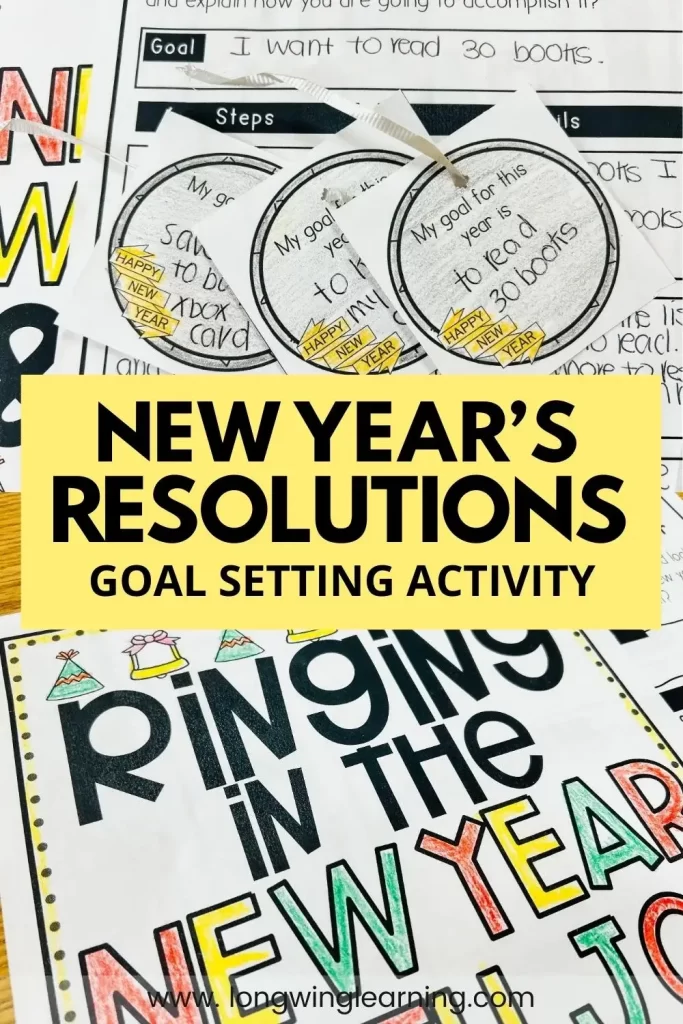
If you want to add another piece to the display, I also use my New Year’s Goal Banners:
Students choose a reading, math, or science goal, and I like hanging the banners on a string above the writing display.
[PHOTO: New Year goal banners displayed above student writing. Alt text: Student New Year goal banners showing reading, math, and science goals.]
Revisit Student Goals After the New Year
I do not want this activity to end as soon as the writing goes on the bulletin board.
The goal is more meaningful when students come back to it.
At the end of January, I like to have students look at their goals again.
We can ask:
- What have you done so far?
- What is working?
- What has been difficult?
- Do you need to change one of your action steps?
These check-ins do not need to become another big assignment.
Sometimes a quick partner discussion or a few minutes of reflection is enough.
You can also revisit the goals once a month or at the end of a grading period.
The Finish Line section of the organizer makes this easier because students have already written how they will know when they have reached their goal.
I think this is one of the most important parts of goal setting.
Students need to see that a goal is something we can come back to, adjust, and continue working toward.
It is not just something we write down in January and forget about.
New Year Goal Setting Writing Prompt for Upper Elementary
If you want to use the same materials I use for this lesson, my New Year’s Goal Writing Prompt includes the planning, writing, and display pieces I described throughout this post.
The resource includes tools to help students move from choosing a goal to planning it and finally writing about it.
It includes:
- goal setting conversation cards
- Goal Choice Board
- Vague or Specific Goal Sort
- five planning sheets
- – two levels of writing frames
- transition word strips
- Writing Buddy revision and editing page
- final writing pages
- paper toppers
- New Year’s quote
- “Happy New Year” pennant banner
[PHOTO: New Year goal setting writing resource cover. Alt text: New Year goal setting writing activity for upper elementary students.]
You can grab the New Year’s Goal Writing Prompt from my TPT store.
If you want to use the writing activity together with the subject-specific goal banners, I am also putting them together in a bundle.
[ADD BUNDLE LINK]
The goal of the entire lesson is simple. I want my students to leave with more than a New Year’s resolution.
I want them to choose something that matters to them, make it specific, and leave with a plan they can actually follow.
Save This New Year Writing Idea for Later
Planning ahead for January?
Save this post to your classroom writing ideas board on Pinterest so you can easily come back to this New Year goal setting writing prompt when you are planning your first week back after winter break.

2 Responses
I downloaded from TPT, still says 2023, but we’re now in 2024? Will you fix?
Yes, I’m in the process of doing that.