

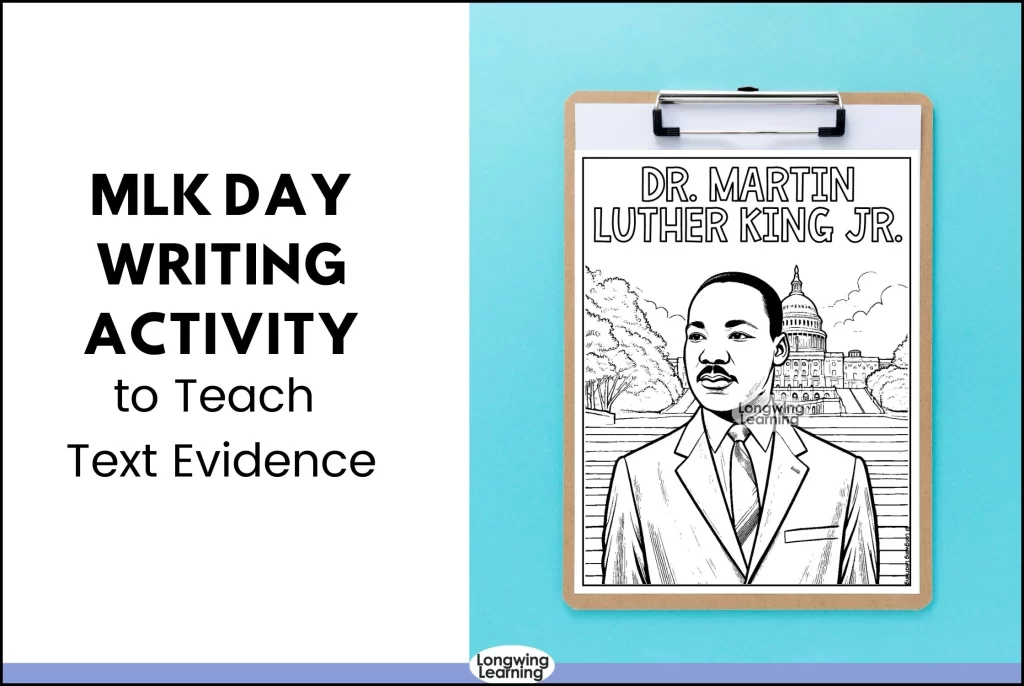
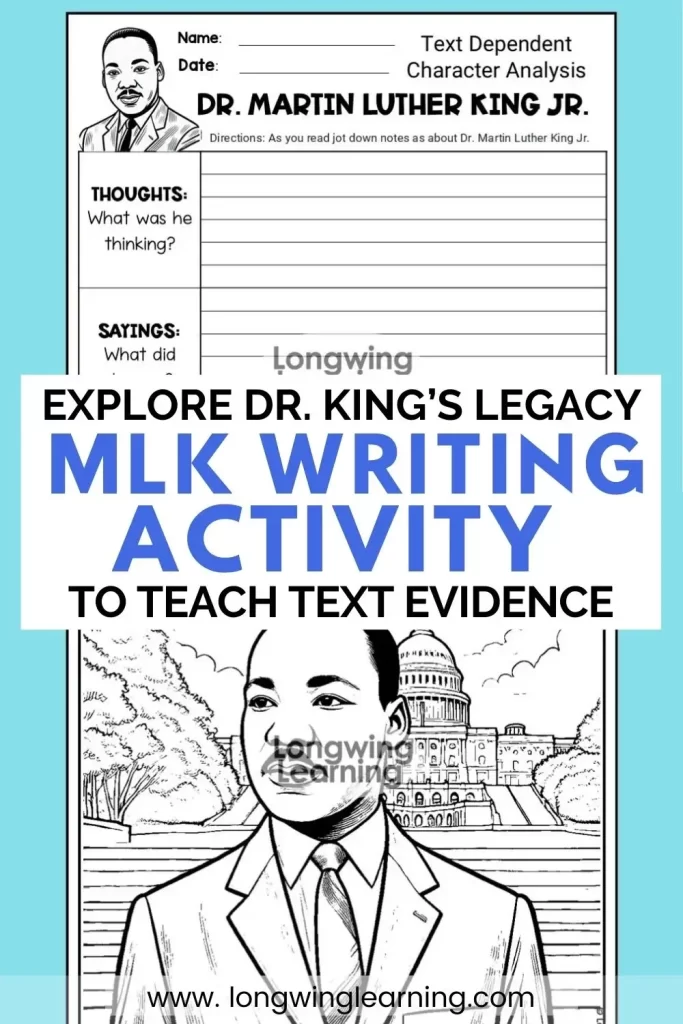
This MLK writing activity gives students a meaningful way to practice text evidence while learning more about Martin Luther King Jr.’s words, actions, and character.
Text evidence is one of those skills that seems simple until students actually have to use it in their own writing.
They can usually find a detail in the passage.
The harder part is explaining how that detail supports what they are trying to say.
That is exactly why I like using this Martin Luther King Jr. writing lesson.
Instead of giving students a random passage and asking them to practice text evidence, they are reading about a person they are already learning about in January.
The writing prompt asks students to think about Dr. King as a person, not just repeat facts from the text.
Students have to decide which character traits describe him, find evidence that supports those traits, and explain what that evidence shows.
That gives us a natural way to work on reading, writing, and elaboration in the same lesson.
In this post, I’ll share why this lesson matters and how you can easily implement it in your classroom.
Start the MLK Writing Activity With Background Knowledge
Before I give students the writing prompt, I want them to know enough about Dr. King to actually have something to say.
The activity includes paired passages, but I also like using a picture book, short article, or video before we begin.
This part does not have to take long.
Even one good read-aloud can give students important context about Dr. King’s life, beliefs, accomplishments, and the challenges he faced.
If your students need more background knowledge, I put together a separate list of MLK books for kids and kid-friendly articles you can use before starting the writing lesson.
Once students have that foundation, the writing prompt makes much more sense.
Introduce the MLK Writing Prompt
The question students respond to is:
What kind of person was Dr. Martin Luther King Jr. based on his thoughts and actions?
Before students write anything, we unpack the question together.
I ask them what the phrase “what kind of person” is really asking.
Usually, students quickly realize that we are talking about character traits.
Then we brainstorm words that could describe Dr. King.
- Courageous.
- Determined.
- Compassionate.
- Hopeful.
- Peaceful.
- A strong leader.
At this point, I remind students that choosing a character trait is only the beginning.
They still have to prove it.
Find Text Evidence That Supports the Character Trait
This is where we go back into the passages.
If a student says Dr. King was courageous, I ask:
What did he say or do that makes you think that?
If a student says he was determined, I ask:
Which detail from the text shows determination?
Students highlight or record details that support the trait they selected.
One thing I notice is that students often want to grab the first detail they see.
So we talk about choosing the strongest evidence, not just any sentence from the passage.
The evidence should actually help answer the prompt.
Teach Students to Explain the Evidence
This is usually the part students need the most help with.
They can write the character trait.
They can copy the evidence.
Then they stop.
I do not want the paragraph to become:
Dr. King was courageous. The text says ____.
That is not enough.
Students need to explain what the evidence shows.
So after they find a detail, I ask:
What does this tell us about Dr. King?
Why does this example show courage?
How does this connect back to your character trait?
Those questions help students move from simply inserting evidence to actually elaborating on it.
For students who need more support, sentence starters can help them get the explanation started.
For example:
This shows that Dr. King was ______ because ______.
This example shows ______ because ______.
Dr. King’s actions show that he was ______.
The goal is not for students to depend on sentence starters forever.
I use them as a bridge until students become more comfortable explaining their thinking independently.
Plan the MLK Writing Response Before Drafting
Once students have their character trait and evidence, I have them organize everything before writing the full response.
This saves us a lot of frustration later.
Students record their main idea or character trait, evidence from the text, what the evidence shows, and any additional details they may want to include.
I like separating the evidence from the explanation on the graphic organizer.
It makes it much easier for students to see that those are two different parts of their response.
Finding the evidence answers “What happened?”
Elaboration answers “What does this show?”
That distinction makes a big difference when students begin drafting.
Draft the Text Evidence Writing Response
After planning, students are ready to turn their notes into a complete response.
At this point, I do not want them searching through the passage for brand-new ideas.
Most of the thinking should already be on the organizer.
Their job now is to turn that planning into clear sentences and paragraphs.
Depending on the student, I might give them a more guided writing frame or let them draft independently.
The structure can be adjusted based on how much support your students need.
Revise and Edit the MLK Writing Activity
Once students have a draft, we go back through it with a very specific purpose.
I do not tell students simply to “check their writing.”
That is too broad.
Instead, I give them a few things to look for.
Did I clearly answer the prompt?
Did I identify a character trait?
Did I include evidence from the text?
Did I explain what the evidence shows?
Does my explanation connect back to my main idea?
Then we move into editing for capitals, punctuation, spelling, and complete sentences.
Students can also work with a partner to read each other’s responses and give feedback.
Sometimes another student notices immediately when the evidence is there but the explanation is missing.
Publish and Display the MLK Writing
Once students have revised and edited their responses, they can create a final copy.
You can stop there, or turn the writing into a simple January display.
The finished writing is more meaningful to me than a bulletin board that is only decorative because students actually have something they worked through and can be proud of.
My
includes final writing pages and display pieces if you want everything ready to use.
Why I Like Using This MLK Writing Activity for Text Evidence
What I like most about this lesson is that students are practicing a skill we already need to teach.
I am not adding an unrelated holiday activity just because Martin Luther King Jr. Day is coming up.
Students are reading informational text, analyzing character, finding evidence, elaborating, drafting, revising, and editing.
The topic gives the writing a meaningful purpose.
And because students have spent time learning about Dr. King first, they usually have much more to say when it is time to write.
Try This MLK Writing Activity in Your Classroom
If your students struggle with text evidence, I would not start by asking them to write an entire response independently.
- Break the thinking apart first.
- Choose the character trait.
- Find the evidence.
- Explain what it shows.
- Then put everything together.
That is the process I use with this Martin Luther King Jr. writing lesson, and it makes the final writing much more manageable for students.
If you want to use the same passages, graphic organizers, writing supports, revision tools, and final writing pages, you can find the complete MLK writing activity in my TPT store.
Planning your Martin Luther King Jr. lessons for January?
Save this post to Pinterest so you can come back to this MLK writing activity when you are ready to teach text evidence.
Check Out Other MLK Writing Activities
- Writing Bio Poems to Celebrate Martin Luther King Jr.
- Big Kids Activities and Resources for MLK Day
- Teaching Diversity Through Picture Books: Booker T. Washington
- Practical Strategies for Teaching Elaboration and Adding Detail in Writing
- How to Explain Text Evidence to Boost Writing Skills in 4th Grade: A Writing Strategy